Somewhere to Put It Down: The Three-Surface Rule for Small UK Living Rooms

Photo: michael ely, CC BY-SA 2.0, via Wikimedia Commons
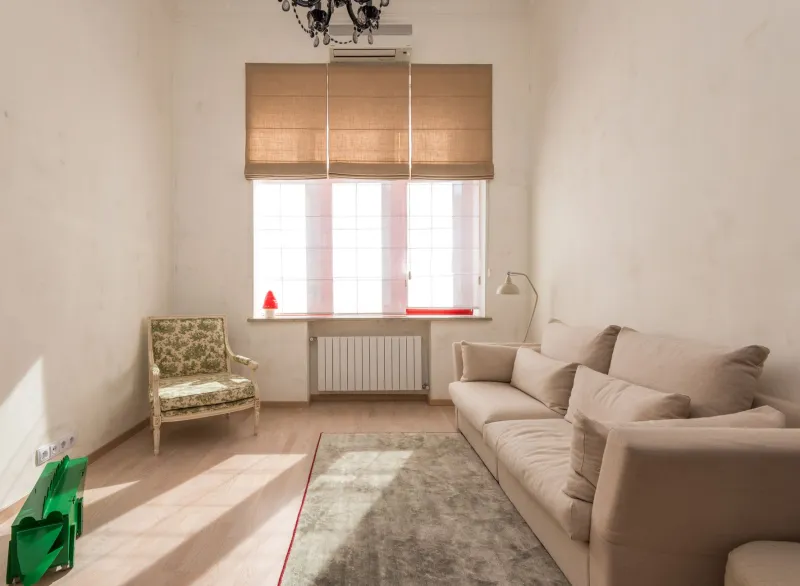
Walk into most small UK living rooms and you can spot the problem before you sit down. The sofa is fine. The rug is fine. The telly is doing its thing. But the room has no landing strip. Coats end up over chair backs, mugs balance on the armrest, the lamp lives on the floor beside the plug socket and the book you're halfway through is facedown on the cushion. None of this is a furniture failure. It's a surface failure.
The three-surface rule is a way of fixing that without turning a 3.5m by 4m room into a furniture showroom. It asks for three working surfaces, each with one clearly defined job: a landing spot, a lamp surface and a drink table. Not three matching side tables from a catalogue spread. Three small, useful planes that stop the floor, the sofa arms and the windowsill from becoming the default storage system.
Start with the jobs, not the furniture
Before you buy anything, name the three jobs out loud. The landing spot is where the phone, the post, the remote and the mug go when you come in or sit down. The lamp surface holds a lamp and perhaps a small clock or a pair of glasses. The drink table sits close enough to the sofa that you can reach a cup of tea without doing a small gymnastics routine.
If one surface can genuinely do two jobs — a slim console behind the sofa that holds a lamp at one end and a mug at the other — that's fine. What doesn't work is one surface trying to do all three. That's how you end up with a tower of post, a lamp wobbling on a stack of books and nowhere to put your brew.
The landing spot: 40cm of somewhere
In a small room, the landing spot is usually best placed at the end of the sofa nearest the door, or on the wall you see first when you walk in. A side table around 40–45cm wide and 40cm deep is enough for a mug, a phone and a small tray for keys. Height matters more than width: aim for 60–65cm, roughly level with the sofa arm, so you're not reaching down to the floor or up to a shelf.
If floor space is genuinely tight, go vertical. A wall-mounted shelf 60cm wide and 20–25cm deep, fixed at about 70cm from the floor, gives you a landing spot without eating into the walkway. A slim console table 25–30cm deep behind the sofa does the same job and can hold a lamp at one end. Just measure the gap between the sofa back and the wall first — 30cm is workable, 20cm is a squeeze, and anything less is a shelf, not a table.
The lamp surface: stable beats stylish
A lamp needs a stable base. The classic mistake in small rooms is buying a delicate pedestal table with a 25cm top, then balancing a 30cm lamp base on it. The lamp overhangs, the table wobbles and you spend the evening waiting for a crash.
Aim for a surface at least 35cm square, or a round top of 35–40cm diameter, with a height of 55–65cm. A small nest of tables works well here because you can pull the lower one out as a drink table when someone visits and push it back afterwards. A solid little chest or a stack of two sturdy storage boxes can also do the job if the lamp is light and the surface is flat.
Think about the plug, too. The lamp surface should be within reach of a socket without a trailing lead across the room. If the only socket is on the opposite wall, a rechargeable lamp or a wall light is a better answer than a long cable and a trip hazard.
The drink table: close enough to reach without getting up
The drink table is the one people skip, and it's the one that saves the sofa. It needs to be within arm's reach of your seated position — roughly 50–60cm from the sofa cushion, not across the room. A small round table 35–40cm in diameter and 50–55cm high is ideal. A C-shaped table that slides over the sofa arm is even better in a tight room because it takes up no floor space at all.
If you don't want another piece of furniture, a sturdy wooden stool or a slim tray table can do the job. The test is simple: sit down, reach for an imaginary mug, and see whether you can put it down without leaning forward or twisting. If you can't, the table is in the wrong place.
What about the telly, the plant and the record player?
They don't count. A TV unit, a plant stand and a record player are furniture with jobs of their own. The three-surface rule is about the small, boring surfaces that stop clutter accumulating. If a surface is already full of technology, it isn't a landing spot — it's a shelf.
The other rule is one in, one out. If a new small table arrives, something else leaves. In a room under 12 square metres, three small surfaces is usually the sensible maximum. Four is a maze. Five is a storage unit with a sofa in it.
Layout fixes when there's no floor space at all
Some rooms genuinely have no spare corners. In that case, borrow surfaces from the walls. A narrow floating shelf above the radiator (leaving the recommended 15cm clearance) can hold a lamp if the shelf is deep enough and the lamp is small. A tray that clips over the sofa arm gives you a drink table without a table. A slim console behind a freestanding sofa can hold a lamp and a landing tray.
Keep the walkway clear. In a small living room, 60–75cm between the sofa and the opposite wall is the difference between a room that works and a room you sidle through. Every surface you add should sit outside that path, not in it.
The point isn't three tables
It's friction. When there's somewhere obvious to put a mug down, you stop balancing it on the arm of the sofa. When the lamp has a stable home, you stop moving it to the floor to plug in the hoover. When the post has a tray, it stops colonising the coffee table.
Three small surfaces, each with a job, will do more for a cramped living room than a new sofa. Start with the landing spot. Then the lamp. Then the drink table. Measure the gap, check the plug, and buy the narrowest thing that does the job properly.