No Holes, No Regrets: Furnishing a Rented Flat Like You Actually Live There
Renting gets talked about as though the only options are live with it or break the tenancy agreement. Neither is true. The trick is to stop treating the flat as a blank canvas you're not allowed to touch and start treating it as a set you can dress.
Everything below is freestanding, removable or reversible. Nothing needs a drill, a landlord's blessing or a spray gun. And all of it comes out again on moving day without a scrap of filler.
1. Choose tall and freestanding over fitted and fixed
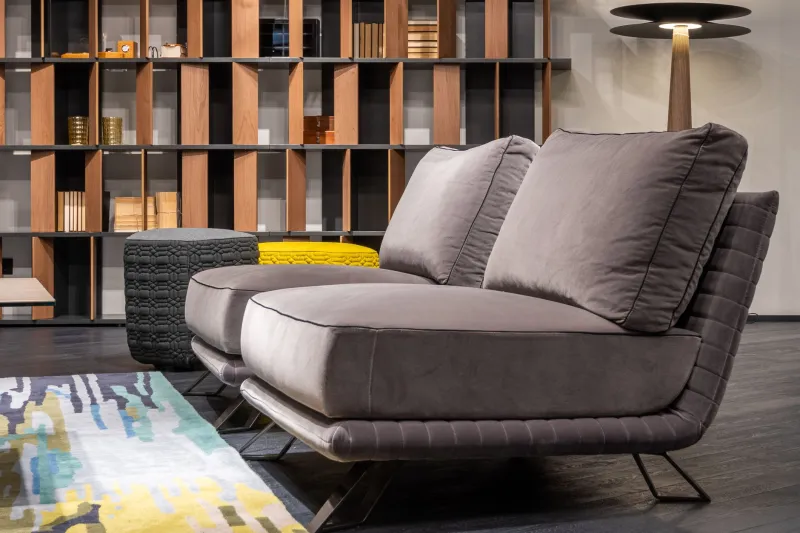
The fastest way to make a rental feel settled is height. A tall freestanding bookcase or open shelving unit pulls the eye upward, hides the fact that your stuff is a work in progress, and — crucially — needs no wall fixings.
Two caveats, both practical. First, anything over about a metre tall should be strapped. Anti-tip straps are a safety matter, not a decorating choice, and most letting agents will happily agree to a single small fixing in writing when you frame it that way. Second, check the floor. Some older conversions have floors that slope by a couple of centimetres across a room, so pack the feet rather than shoving wedges of card under there and hoping.
2. Buy modular, because your stairwell is the real enemy
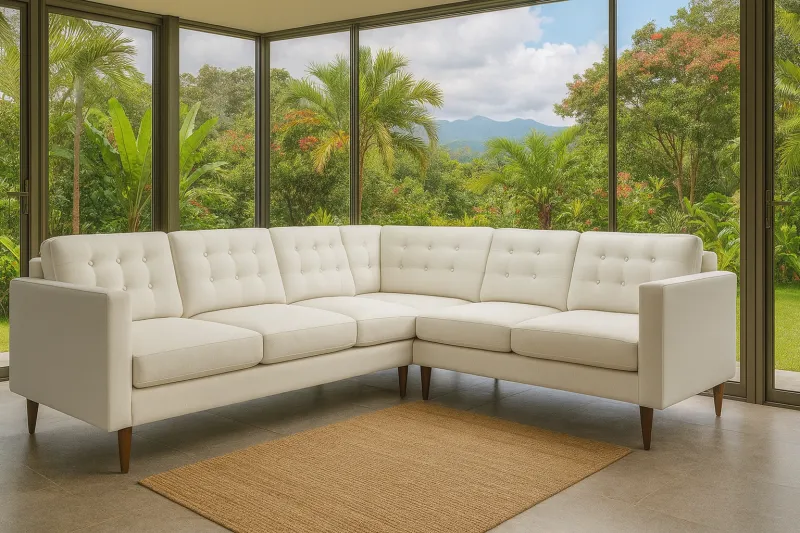
That beautiful two-metre sofa in the showroom has to get up a dog-leg staircase and around a corner with 70cm of clearance. Measure the door widths, the hallway and the tightest turn before you order, then favour pieces that come apart. Modular sofas, flat-pack wardrobes and knock-down bed frames are not a compromise in a rental — they're the difference between a delivery and a collection.
3. Put your money into washable covers
The single best purchase for a renter with a beige sofa is a zip-off, machine-washable cover. Same for dining chair seats and any cushion that gets sat on. It's not about hiding the landlord's taste, it's about never having to explain a coffee ring at checkout.
Check the fire safety label while you're at it. Upholstered furniture sold in the UK should carry one, and if you're buying secondhand, don't take on upholstery without it. It's dull advice that saves real trouble.
4. Use no-drill fixings honestly
Tension rods, spring-loaded poles, over-door hooks and adhesive strips are the renter's toolkit. They work well within their limits and badly beyond them.
- Adhesive strips have stated weight limits for a reason — halve them in your head and you'll be about right. They hold best on smooth, sealed, flat surfaces and fail on textured wallpaper, freshly painted walls and anything above a radiator.
- Tension rods are brilliant for a shower curtain, a doorway curtain or a lightweight shelf across a chimney recess. They are not a solution for a heavy blackout curtain over a draughty sash window unless you buy a rod rated for it.
- Removal matters as much as fitting. Warm the strip gently with a hairdryer and ease it off slowly rather than yanking. Test any adhesive on a hidden patch first, ideally somewhere nobody will ever look.
5. Let rugs do the work of the flooring
You cannot replace the carpet. You can absolutely change the floor. A large rug in the living room, a runner in the hall and a washable mat by the kitchen door makes the flat feel intentional rather than inherited.
Two things people get wrong. Buy bigger than feels sensible — a rug that floats in the middle of the room makes everything look smaller. And always use an anti-slip underlay, especially over carpet, or you'll be straightening the thing every morning for a year.
6. Light with lamps, not with the ceiling
You're not going to rewire anything, and you don't need to. A floor lamp in the corner, a table lamp on a sideboard and a plug-in wall light or two will do more for a rented room than any amount of soft furnishing, because they sit at human height instead of shining down from the middle of the ceiling.
Warm bulbs (2700K), several small sources rather than one bright one, and a dimmer plug if you want to be fancy. It's the cheapest transformation available and it moves house with you.
7. Leave the building's working parts working
This is the one renters skip and regret. Whatever you bring in, keep radiators clear, keep windows able to open, keep trickle vents unblocked, and don't park a wardrobe in front of the only socket in the room. In an older flat, cold spots and condensation are the things that turn into deductions, and a wall of furniture pushed flush against a cold external wall is how you get damp patches behind a bookcase.
So: a 10cm gap behind freestanding furniture on external walls, nothing within half a metre of a radiator, and curtains that actually close. Boring, yes. Deposit-friendly, extremely.
The checks that save you an argument in eighteen months
Before any of this, photograph everything. The inventory, the marks on the wall, the worn patch by the door, the scratch on the worktop. Keep those photos somewhere other than a phone you'll upgrade.
Then read the tenancy agreement for the clause about fixings, and if it's ambiguous, ask the agent in an email so you have an answer in writing. Keep receipts for anything you buy that might be argued about later. Know which deposit scheme your money is in. And check your contents insurance actually covers a rented property — many policies sold to homeowners don't.
None of that is decorating. All of it is what makes decorating possible without a low hum of worry underneath it.
The flat isn't yours on paper. It can still be yours in the way that matters: the lamp that makes the corner glow at six o'clock in November, the rug that kills the beige, the shelves that hold the books that say something about you. Furniture you can take with you is not a compromise. It's the whole point.