Leave a Lane: Planning a Small Room Around the Routes You Actually Use
The sofa looked right in the shop. It looked right in the doorway. It looked considerably less right on a wet Wednesday when the shopping bags were in one hand and the dog was trying to get past on the other side. Nothing was wrong with the sofa. Something was wrong with the lane.
Most small-room furniture problems are not style problems. They are circulation problems. We fall for a floor plan that shows a neat arrangement of rectangles, then discover that the rectangles have doors, drawers and people attached to them. At 925 Furniture, the practical rule is simple: furnish the floor you can actually walk through. Everything else is decoration with a delivery charge.
Begin at the hinge, not the wall
Walk into the room and ignore the walls for a minute. Look at the doors. All of them — the main one, the cupboard, the one under the stairs, the little door to the boiler. Note which way each one opens, how far it swings, and what it would hit if something were standing there. A door that opens into a room owns a quarter circle of floor. That quarter circle is not a display area. It is a lane, and it needs to stay clear.
Do the same for anything else that moves: wardrobe doors, drawer fronts, the oven, the washing machine, the ironing board you keep meaning to put away. In a Victorian terrace or a 1930s flat, these arcs often overlap. Two doors opening into the same square metre is not a design flaw; it is just reality. The audit simply makes it visible.
Two kinds of clearance, and only one of them is negotiable
There is delivery clearance and there is everyday clearance. Delivery clearance is the once-only business of getting a piece through the front door, up the stairs and around the bend. It can be temporary. You can take a door off its hinges, protect a banister, or book two strong people and a bag of felt pads. It is worth checking before you buy, but it is not the same as living with the thing.
Everyday clearance is the bit that has to work on a Tuesday morning when you are late. Can you open the living room door while carrying a laundry basket? Can a guest get to the loo without climbing over the coffee table? Can you reach the radiator to bleed it? If the answer is no, the furniture is in the wrong place — or it is the wrong furniture. A piece that got in is not automatically a piece that works.
Tape, paper and a week of honest walking
You do not need software for this. Masking tape is enough. Mark the door swing arcs on the floor in a colour that will annoy you slightly, because you want to notice them. Then mark the main route through the room — from the door to the window, the door to the kitchen, the sofa to the telly — at about 60 to 70 centimetres wide for one person. If two people need to pass regularly, give it more.
Cut paper or cardboard templates for the furniture you are considering, including the bits the dimensions leave out: handles, radiator valves, the swing of a cupboard door. Leave the templates down for a week. You will quickly learn which ones you step over, which ones collect shoes, and which ones make the room feel like a corridor with a sofa in it. A cardboard box at seat height is a surprisingly good stand-in for a chair, too. Sit in it. Try to get out of it without knocking the lamp over.
The point is not to be fussy. The point is to avoid buying something that only works in a photograph.
The things that open are part of the footprint
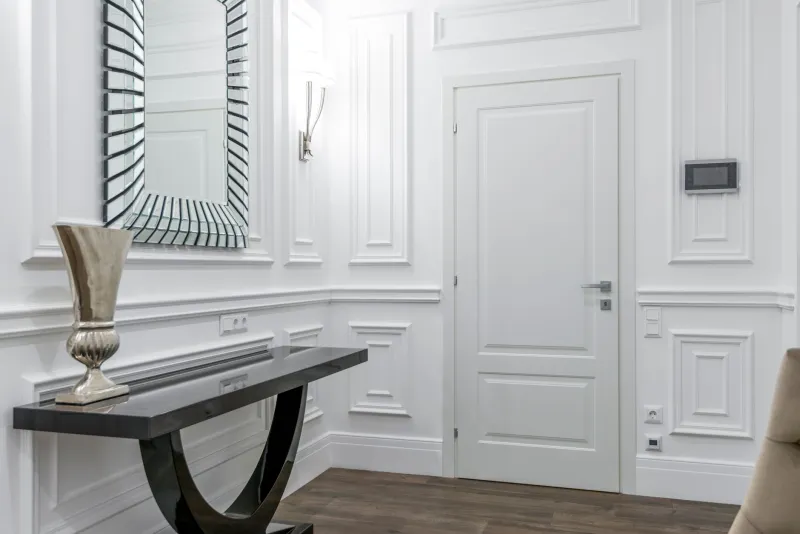
A chest of drawers is not just the width of its front. It is the front plus the drawer pulled out. A wardrobe is the depth plus the space you need to stand in while choosing a shirt. A slim hallway console can be lovely, but only if the front door does not open into it. In small rooms, the opening distance is often the real dimension — and it is the one the product page rarely mentions.
This is where a lot of rental living goes wrong. You cannot move the door, you cannot move the boiler, and you would rather not put holes in the wall. The answer is usually a shallower piece, a taller piece, or a piece that does a different job. A narrow wall-mounted shelf above a radiator can replace a floor-standing unit. A shallow console of 18 to 22 centimetres can hold keys and post without becoming a knee-height obstacle. A storage bench with a lift-up lid needs less forward clearance than a chest of drawers.
Fixes for the tight spots
If the swing is the problem, sometimes the door is the cheapest thing to change. Rehanging an internal door to open outwards can reclaim a useful square metre, though never mess with fire doors or anything that affects a rented property without checking first. A sliding door or a curtain over a cupboard can work in a tight corner, and removing a cupboard door altogether — storing it carefully if you rent — turns dead space into open shelving.
Door stops are underrated. A simple wall-mounted stop saves handles, paintwork and the edge of a bookshelf. Recessed handles on furniture reduce the accidental catch factor. And if a floor lamp is eating the only clear corner, a wall light or a slim shelf light may be the better trade. None of these are grand gestures; they are just the small corrections that make a room stop fighting you.
The final test
When the tape comes up and the furniture is in, do the walk-through properly. Carry something awkward. Open every door. Sit down and get up. Ask someone else to squeeze past. If you have to apologise to them, the lane is too narrow.
A small room does not need less personality. It needs a clearer route through it. Once the doors, drawers and paths are accounted for, the remaining floor is yours to furnish — and it will feel bigger, not smaller, because you are no longer using it as a storage solution for your own furniture.