Short Rooms, Long Views: A Practical Plan for Low-Ceiling Living
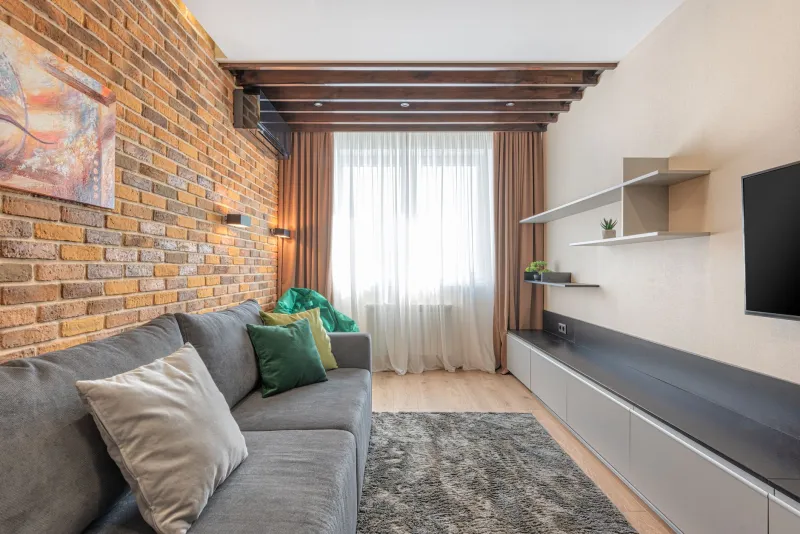
There's a particular moment when you stand up in a new room and your hand goes instinctively to the ceiling. Maybe it's a cottage bedroom with beams, a basement flat in a Victorian terrace, or a loft conversion where the roof does most of the work. The room is lovely. It's just... shorter than you are. Or shorter than you'd like to be, which is a slightly different problem.
The instinct is to treat a low ceiling as something to be fixed. In practice, most of us can't raise a ceiling, and the rooms that have them are often the ones with the most character. What you can do is furnish for the height you actually have, rather than the height you wish you had. That's less about tricks and more about proportions, sightlines and a few honest measurements.
Start With Numbers, Not Vibes
Before you buy anything, spend ten minutes with a tape measure. Measure floor to ceiling in several spots, not just the middle — old buildings sag, beams drop, and loft conversions slope. Note the height of door openings and window heads, because these set the visual rhythm of the room. A standard UK door is around 1.98m, and a typical modern ceiling is about 2.4m. Once you're down around 2.2m or below, low-backed furniture starts to earn its keep.
Also measure the gap above your tallest existing piece. If a wardrobe leaves only 15cm of wall above it, that sliver of space will read as a mistake rather than a design choice. Either fill it deliberately or choose a lower piece.
The Half-Height Habit
A useful rule of thumb for short rooms: keep the bulk of your furniture below roughly half the ceiling height. In a 2.2m room, that's about 1.1m. This doesn't mean everything must be tiny — it means the pieces with visual weight should sit low, so your eye travels across the room rather than up into a wall of furniture.
Sofas are the usual culprit. A high-backed sofa in a low room can feel like a second ceiling. Look for back heights around 65–75cm, low arms, and a seat that doesn't disappear into a deep squish. A low-back sofa with visible legs keeps the floor reading as continuous, which makes the room feel wider even when it isn't.
Let the Floor Show
Furniture that sits on legs — or has a visible gap underneath — does a lot of quiet work in a short room. You're essentially giving the eye more floor to travel over. Open-legged coffee tables, bedside tables on slim legs, a sideboard raised on a plinth rather than sitting flush to the carpet: all of these help.
Wall-mounted pieces are the other half of the equation. Floating shelves, a wall-hung TV, a slim wall-mounted desk. Anything that removes a chunk of furniture from the floor plan buys back a bit of breathing room.
Take the Light Off the Ceiling
A pendant hanging from a low ceiling is the fastest way to make a room feel like a caravan. Where you can, move the light source to the walls. Wall lights set around 1.5–1.7m from the floor give you useful pools of light without dropping anything into the middle of the room. Plug-in wall lights are a good option for renters, and picture lights over artwork add a bit of gentle glow without eating headroom.
If you do need a ceiling light, choose something flush or semi-flush and hang it as high as the fitting allows. Over a dining table, a slim linear pendant can work in a short room because it reads as a line rather than a blob. Floor lamps with low, wide shades are another good swap — they light the room at sitting height, which is where you actually are.
Wardrobes: Tall, Slim and the Same Colour as the Wall
This is where low-ceiling rooms get tested. A standard wardrobe is around 2m tall and 60cm deep. In a 2.2m room, that leaves a narrow strip of wall above it that can look like the wardrobe is bursting out of the floor.
There are three sensible routes. The first is full-height joinery that runs cleanly to the ceiling, painted the same colour as the walls so it reads as part of the architecture rather than a piece of furniture. The second is a genuinely low, wide chest of drawers — around 80cm high — which gives you storage without the vertical mass. The third is a slimline wardrobe, often 45cm deep, which works for folded clothes, shoes and short-hang items, though it won't take a full-length coat comfortably.
What I'd avoid is a tall wardrobe with a stack of boxes on top. It draws the eye upwards and makes the ceiling feel closer than it is.
Paint the Room as One Thing
A bright white ceiling against coloured walls creates a hard horizontal line at the top of the room, and that line is exactly where you don't want people looking. Painting the ceiling the same colour as the walls, or a shade lighter, softens that edge and lets the room read as one volume. It's a small change with a surprisingly big effect.
Curtains should run from just below the ceiling line to the floor, and be wide enough to cover the window properly when closed. A short curtain that stops at the sill chops the wall in half. Rugs should be generous, low-pile and light in tone — a small dark rug on a light floor will make the room feel like it's shrinking.
Beams and Bulkheads Are Not the Enemy
If you have beams, paint them the same colour as the ceiling rather than fighting them with contrast. A dark beam against a white ceiling will pull the ceiling down visually. Boxed-in bulkheads are a good place for low furniture — a bench, a low shelf, a reading chair — because the awkward height is already accounted for.
The Last Few Percent
Hang artwork at a comfortable eye level, not up near the picture rail. Choose low, wide planters over tall plants. Use mirrors to bounce light from a window rather than to reflect the ceiling back at you. And resist the urge to fill every wall — a short room with a bit of empty space feels far more generous than one packed to the rafters.
Low ceilings aren't a flaw to be apologised for. They're a proportion to design around, and once you've measured properly and chosen furniture that respects the height, the room tends to settle into itself. Short rooms can feel snug, calm and quietly clever. You just have to stop decorating for the ceiling you don't have.